Before you buy any diamond online, verify these five things:
What material the grading report names — not whether a report exists
Which laboratory issued it — and whether you can look up the number yourself
Whether the price is physically possible for the stone described
Whether the material terms are consistent across the title, specifications, and description
Whether the photographs are the seller's own
Each one takes under a minute.
Buying a diamond online looks simple. Search the shape, carat weight, and price you want, scroll the photos, compare listings.
The hard part is knowing whether the listing describes what you're actually buying. Most online diamond listings are straightforward. Some use a confusing stack of material terms, an impossible price, reused photography, or documentation that looks official and isn't.
You don't need to be a gemologist to catch it. A handful of specific checks will tell you whether a listing deserves your money or another question first.
Start With What the Grading Report Says — Not Whether One Exists
The most common mistake is treating any report as proof of a diamond. What matters is what material the report names.
A grading report from the International Gemological Institute (IGI) or the Gemological Institute of America (GIA) gives you something you can verify independently, rather than relying on a product title. But these labs don't only grade diamonds. IGI has issued grading reports for moissanite since 2022, and expanded that significantly in 2024. A genuine IGI report can sit behind a listing and describe a stone that isn't a diamond at all.
That's not a trick — the report states exactly what the stone is. The problem is when a seller waves the existence of a report as though it settles the question, and the buyer never reads what it says.
Ask for the report number, then look it up on the lab's own database. Confirm these match the listing:
The material the report identifies — lab grown diamond, natural diamond, or something else
Carat weight, shape, and measurements
Color and clarity grades
The laboratory name and report number
If the details don't line up, or the seller can't produce a number you can verify, that's your answer.What IGI certified actually means walks through how to read one properly.
The "GRA Certificate" Is Not a Lab Report
If a listing's documentation comes from "GRA," you're not looking at an independent grading report.
GRA stands for Gemological Research Association, and it accompanies a large share of inexpensive moissanite and simulant listings online. The distinction that matters is accreditation. GIA, IGI, and AGS are independently accredited gemological laboratories with published standards, trained graders, and verification databases you can query yourself. GRA is not an accredited testing laboratory, and its cards are typically issued by the manufacturers selling the stones rather than by an impartial third party.
The certificate layout closely resembles GIA's, which is why it reads as official at a glance. That resemblance is doing most of the work.
This doesn't mean a stone sold with a GRA card is worthless, and it usually isn't a forgery. It means the document functions more like a seller's spec sheet than an assessment by an impartial gemologist who examined your specific stone. It carries the visual authority of a lab report without the independence that makes a lab report meaningful.
One phrase worth memorizing:"GIA-certified moissanite" describes something that does not exist. GIA doesn't grade moissanite. If you see that combination in a listing, stop reading and ask a direct question.
When the Price Can't Be Real
Price alone doesn't identify a stone, but it tells you when to slow down.
A listing offering a 2-carat "lab grown diamond" for $26 isn't offering a lab grown diamond. Lab grown diamonds cost dramatically less than mined stones, but they still require growth time, cutting, polishing, grading, and distribution. There's a floor, and $26 is nowhere near it.
A listing offering a 2-carat "lab grown diamond" for $26 isn't offering a lab grown diamond. Laboratory synthesis requires controlled energy, specialized seed handling, and time in a reactor — and beyond the growth itself, there's an irreducible floor to cutting, polishing, grading, and distribution. Lab grown diamonds cost dramatically less than mined stones. They don't cost nothing.
An impossible price usually means one of three things: the stone is a simulant described loosely, the center stone is something other than what the title implies, or the listing is using diamond language as a search term rather than a description.
Inexpensive doesn't mean dishonest. But when the number can't be explained by anything except a different material, treat that as the first question rather than the last.
Watch for Contradictory Material Terms
A title that stacks several different materials together isn't being thorough. It's being unclear.
Listings like"lab grown diamond moissanite simulant" appear constantly, and they describe three distinct things. A lab grown diamond is a real diamond created in a controlled environment. Moissanite is a separate gemstone with its own chemistry — a legitimate choice that many people deliberately prefer, but not a diamond. A simulant is any material chosen to imitate a diamond's appearance, most commonly cubic zirconia.
Those words aren't interchangeable, and a listing using all three hasn't told you which one is in the ring.
If a seller calls the stone a lab grown diamond in the title and a simulant in the specifications, ask which it is before buying. A clear listing makes the center stone's identity obvious without requiring interpretation.What "simulated diamond" actually means breaks down the terminology in full.
If This Isn't Allowed, How Are Sellers Doing It?
It isn't allowed. It's just not enforced at the scale these listings operate on.
The Federal Trade Commission updated its Jewelry Guides in 2018 and removed the word "natural" from the definition of a diamond. A diamond is now defined by what it is —pure carbon crystallized in the isometric system — rather than by where it came from. That's why a lab grown diamond is correctly called a diamond.
What the FTC did not do is open the word up to everything else. The Guides are explicit that a seller must clearly disclose when a stone is lab grown rather than mined, and they specifically prohibit calling a simulant a diamond. Moissanite cannot be marketed as a synthetic diamond, a created diamond, or any other phrase that attaches the word diamond to it. Cubic zirconia can't either.
The gap is enforcement. The Jewelry Guides are guidance rather than statute, so a violation gets addressed when the FTC pursues it, a competitor sues, or a consumer sues. Against a domestic retailer that's a real deterrent. Against thousands of overseas marketplace listings that appear and disappear weekly, it functionally never happens.
That's the practical reality worth understanding: the rules describing what a seller may call a stone are clearer than most buyers assume. The reason misleading listings persist isn't ambiguity in the rules. It's that nobody is checking, which puts the verification back on you.
Be Careful With "Handmade" Claims
"Handmade" isn't regulated, and it can describe almost any production process.
CAD and CAM are standard tools in modern jewelry, including in genuinely custom work. A computer in the process doesn't mean a craftsperson wasn't involved.
The concern is narrower than that. It's a listing leaning hard on "handmade" while everything else about it points to overseas mass production — and a seller who won't explain the difference when you ask.
Ask where the design was created, where the piece is manufactured, and who inspects it before it ships. A transparent seller can answer all three without difficulty.
Check Whether the Photos Are Actually Theirs
Photos make a listing convincing, but they don't prove the seller has ever held the piece.
If the same ring image appears across several unrelated shops, that's worth pausing on. A reverse image search often surfaces this quickly, and so does comparing backgrounds, cropping, angles, and watermarks between listings.
Reused photography isn't automatically dishonest — multiple retailers legitimately use manufacturer images. It becomes a problem when generic photographs are presented as pictures of the seller's specific inventory.
For anything meaningful, ask for:
A photograph of the actual stone or finished piece
A video showing it from multiple angles
A photograph of the grading report itself
The report number, so you can verify it independently
A seller who has the piece can produce these without hesitation.
Look at Who's Actually Selling
The seller's own account often tells you more than the product description does.
A pattern worth recognizing: a storefront whose account name references cubic zirconia, listing a stone as moissanite, documented with a GRA card, shipping from overseas — all visible on one page without asking a single question. No individual detail there proves anything. Together they describe what the seller actually deals in.
Look at what else the shop sells. Look at how long the account has existed. Look at whether the stated origin in the description matches the shipping information at checkout. Inconsistency between what a listing claims and what the surrounding page shows is the most reliable signal available to you.
No Single Signal Decides It
The strongest warning isn't any one red flag. It's several appearing together.
A low price might have a real explanation. A stock photo might come from the manufacturer. A handmade piece might involve CAD. But an impossible price, plus contradictory material terms, plus GRA documentation, plus generic photography is not a coincidence — it's a description of the same listing four different ways.
Treat online shopping as verification rather than reading. The title is marketing. The specifications, documentation, photographs, and the seller's answers are where the actual information lives.
If You Already Bought Something and You're Not Sure What It Is
Don't assume you made a foolish decision. These listings are designed to be confusing, and plenty of careful people have bought from them.
Start with whatever documentation came with it. If there's a report number from IGI or GIA, look it up and read what material it names. If there's a GRA card, or nothing at all, the paperwork won't settle it.
At that point an in-person look is the fastest path to an answer. At North & South Jewelry you can bring the stone or the finished piece in and we'll identify it — what the material actually is, and what that means for what you paid. There's nothing embarrassing about asking. The only bad outcome is not knowing.
You shouldn't have to interpret a product title to figure out what you're buying.
A trustworthy listing names the material plainly, backs it with documentation you can verify yourself, and answers direct questions directly. Check what the report says. Check whether the terminology is consistent. Check whether the price is possible. Check whether the photos are theirs.
If you've found a listing you're unsure about, or you'd rather look at certified stones in person before committing to anything, we're always happy to look at what you're considering — whether or not you bought it from us.Come see us or send over what you're looking at.
About the author
Elaine is a custom jeweler and founder at North & South Jewelry in Fullerton, California, where the team has been designing and building custom engagement rings since 1988. Every lab diamond center stone the shop sets is IGI certified before it goes into a setting.
Frequently Asked Questions
How do I know if a lab-grown diamond listing is real?
Ask for the grading report number and verify it on the IGI or GIA database yourself. The critical detail is what material the report names — a real report can describe moissanite just as easily as a diamond.
Can I look up an IGI report number myself?
Yes — IGI maintains a public report verification database on its own site, and GIA does the same. Enter the report number and compare what comes back against the listing, paying particular attention to the material the report names.
Why are some lab-grown diamonds so cheap?
Lab-grown diamonds legitimately cost far less than mined stones because they're produced in weeks rather than found. But there's a production floor, and a 2-carat stone priced at $26 is describing a different material entirely.
Is a GRA certificate legitimate?
GRA isn't a registered gemological laboratory, and its certificates function more like a seller's spec sheet than an independent assessment. The stone may well be what it says, but the document isn't independent verification.
What does it mean if a listing says both moissanite and diamond?
They're different materials, so the listing hasn't told you which one you'd receive. Ask the seller to name the center stone specifically before purchasing.
I already bought one — how do I find out what it is?
Check any report number against the issuing lab's database and read what material it identifies. If there's no verifiable report, an in-person identification by a jeweler is the fastest way to know for certain.
Are all online diamond sellers untrustworthy?
No — most online jewelers provide accurate descriptions, real photographs, and verifiable grading reports. The point isn't to distrust everyone; it's to know which four or five details actually confirm what you're buying.
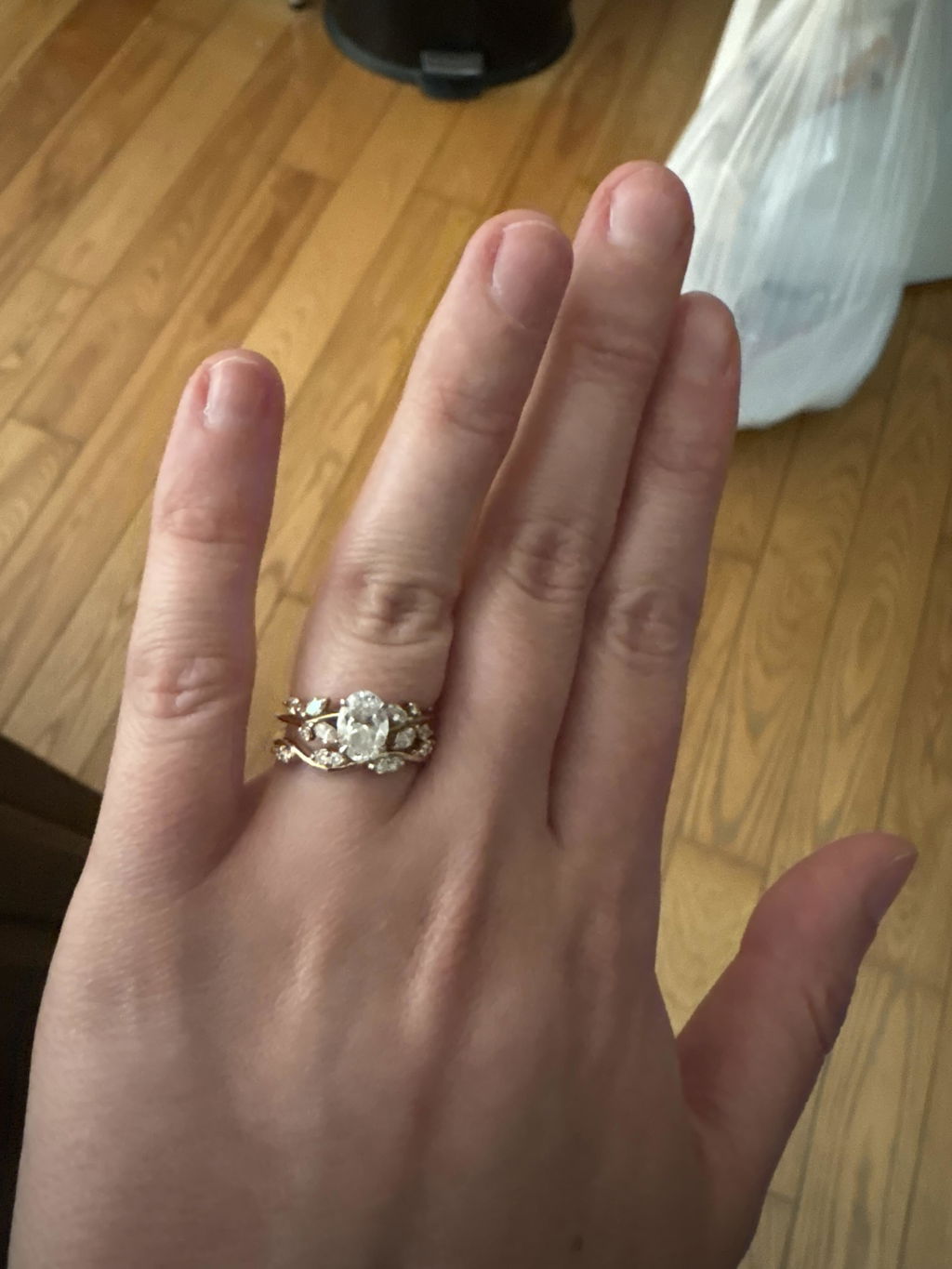
Could not be happier with the Audrey Dutch Marquise and band! Stunning clarity, shape, fit, etc. my wife has been told by multiple people it is the most beautiful ring they’ve ever seen. Also quick turnaround and communication! Have recommended to friends and will be ordering again. Thanks y’all!
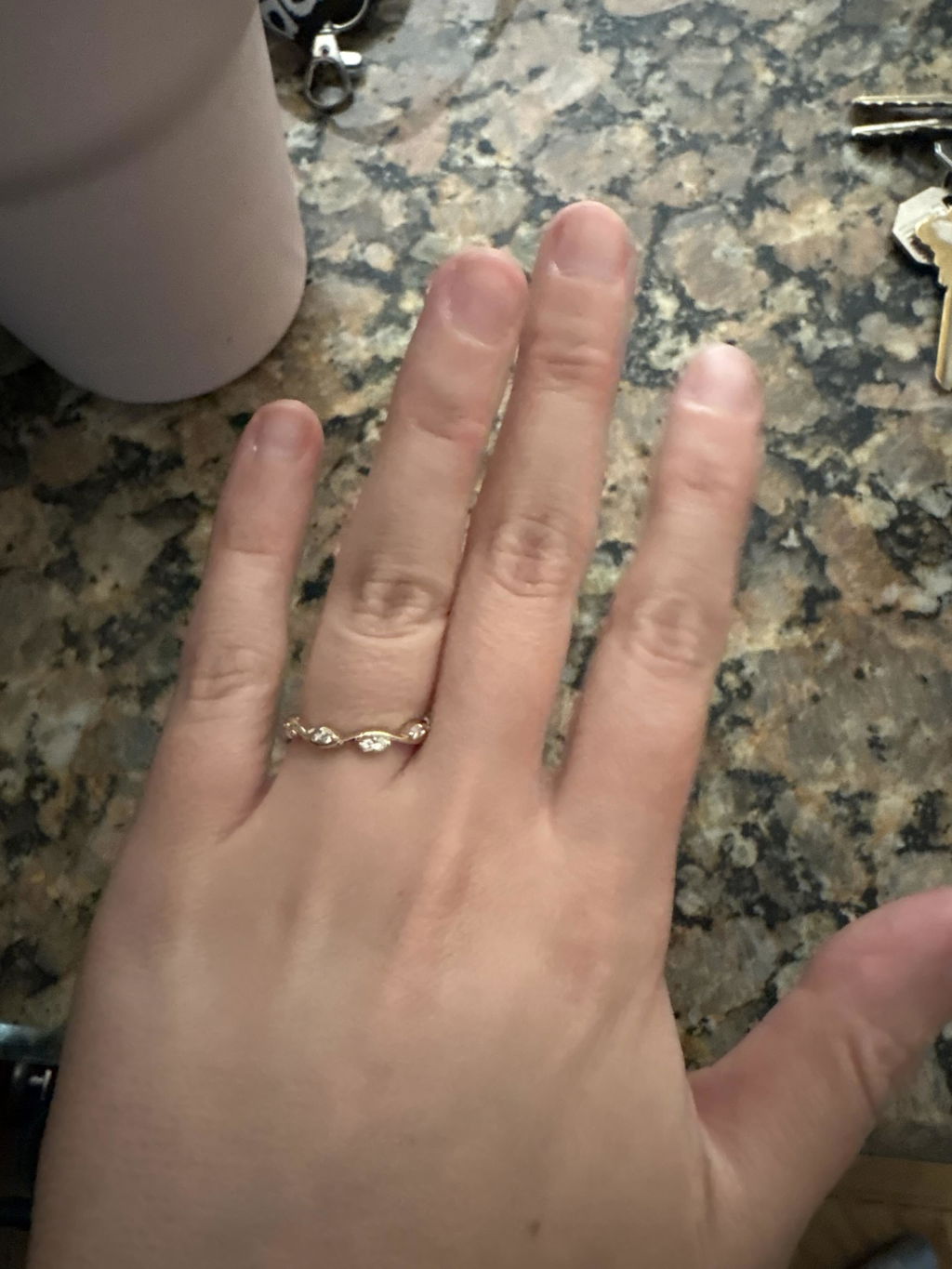
The wedding band I ordered online is perfect. It is a perfect match to my engagement ring. I struggled to find one that would match the floral design of my engagement ring, but once I came across this ring, I knew it was perfect. The ring arrived sooner than I was anticipating and surpassed my expectations.